
Breast Cancer Treatment in Gurgaon
Dr. Pushpinder Gulia provides breast cancer treatment in Gurgaon at CK Birla Hospital, with treatment planned according to the cancer type, stage, tumour characteristics and overall health.

Book an Appointment
Our team will get back to you within a few hours
Breast Cancer Treatment in Gurgaon
Treatment Planned Around Your Diagnosis and Cancer Stage
A breast cancer diagnosis can bring many questions: Do I need surgery? Can the breast be preserved? Will I need chemotherapy or radiation?
The answer depends on the type and stage of breast cancer and its biological features.
At CK Birla Hospital, Gurugram, breast cancer care includes diagnosis, surgery, chemotherapy, radiation therapy and other systemic treatments. The Breast Centre also provides oncoplastic surgery, breast reconstruction, screening and rehabilitation services.
Dr. Pushpinder Gulia focuses on the surgical management of breast cancer, including breast-conserving surgery and oncoplastic procedures.

What Is Breast Cancer?
Understanding the Disease Before Choosing Treatment
Breast cancer develops when abnormal cells in the breast grow and multiply in an uncontrolled way.
It can begin in different parts of the breast and may remain localised or spread to nearby lymph nodes and other parts of the body.
Treatment depends on factors such as:
- Cancer type
- Stage
- Tumour size
- Lymph node involvement
- Hormone receptor status
- HER2 status
- Menopausal status
- Overall health
Types of Breast Cancer
Different Breast Cancer Types May Require Different Treatments
Ductal Carcinoma in Situ
Abnormal cells are confined to the milk ducts and have not invaded surrounding breast tissue.
Invasive Ductal Carcinoma
The cancer begins in the milk ducts and grows into nearby breast tissue.
Invasive Lobular Carcinoma
The cancer starts in the milk-producing lobules and can spread into surrounding breast tissue.
Triple-Negative Breast Cancer
This type does not have oestrogen, progesterone or HER2 receptors. Treatment usually relies on therapies other than hormone- or HER2-targeted treatment.
HER2-Positive Breast Cancer
These cancers have higher levels of the HER2 protein and may respond to HER2-targeted medicines.
Recurrent Breast Cancer
Cancer that returns after previous treatment may require a new assessment and treatment plan.
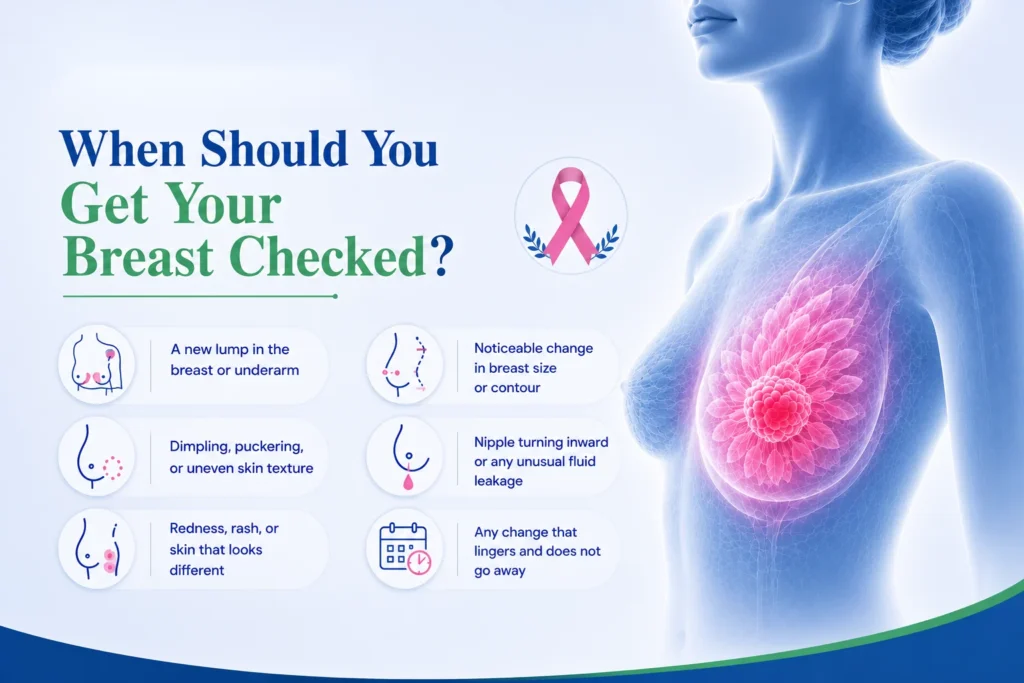
When Should You Get Your Breast Checked?
See a doctor if you notice a new or persistent change such as:
- A lump in the breast or armpit
- Change in breast size or shape
- Skin dimpling or puckering
- Nipple inversion or unusual discharge
- Redness or skin changes
- Persistent breast swelling
- A change that does not settle
Not every breast change is cancer, but a persistent or unexplained change should be assessed.
How Is Breast Cancer Diagnosed?
Tests That Confirm the Diagnosis and Help Plan Treatment
Clinical Examination
The breast and nearby lymph nodes are checked for lumps, swelling or other changes.
Breast Imaging
Mammography and ultrasound help identify and assess breast abnormalities. A breast MRI may be advised in selected cases.
Biopsy
A tissue sample is taken from a suspicious area and examined under a microscope to confirm whether cancer is present.
Pathology & Biomarker Testing
The biopsy is analysed to identify the cancer type and important markers such as oestrogen receptor (ER), progesterone receptor (PR) and HER2.
Staging Tests
Additional imaging, such as PET-CT or other scans, may be recommended to assess the extent of cancer and check for spread when clinically required.
Free first consultation — no obligation
Breast Cancer Treatment Options in Gurgaon
Treatment May Combine Surgery With Other Cancer Therapies
Breast cancer treatment may involve surgery, chemotherapy, radiation therapy, hormone therapy, targeted therapy or immunotherapy. Some patients may need a combination of treatments.
Breast Cancer Surgery: Surgery removes the tumour and may include lymph node assessment or removal. Surgical options include:
- Breast-conserving surgery (Lumpectomy) — removes the tumour while preserving most of the breast.
- Mastectomy — removes the entire breast when required.
- Sentinel lymph node biopsy — checks the first lymph nodes likely to contain cancer cells.
- Axillary lymph node dissection — removes additional lymph nodes when clinically indicated.
- Oncoplastic breast surgery — combines tumour removal with techniques to maintain breast shape.
Chemotherapy: Anti-cancer medicines may be given before or after surgery, depending on the cancer and treatment plan.
Radiation Therapy: Radiation may be recommended after breast-conserving surgery and in selected patients after mastectomy.
Hormone Therapy: Used for breast cancers that have hormone receptors.
Targeted Therapy: Targets specific cancer features, such as HER2.
Immunotherapy: May be considered for selected breast cancers, including some triple-negative breast cancers.
Breast-Conserving Surgery or Mastectomy?
Understanding the Two Common Surgical Approaches
For some women, breast-conserving surgery can remove the cancer while preserving most of the breast. Others may need a mastectomy based on the size, location or extent of the cancer.
Breast-Conserving Surgery
Removes the tumour with a margin of surrounding tissue while keeping most of the breast.
Mastectomy
Removes the entire breast when breast conservation is not suitable or when mastectomy is recommended based on the cancer.
The choice depends on the cancer and the individual patient. Your surgeon will discuss the suitable approach after reviewing your examination, imaging and pathology results.
Why Choose Dr. Pushpinder Gulia?
Dr. Pushpinder Gulia is a Surgical Oncologist in Gurgaon with experience in the surgical management of breast cancer. His areas of breast cancer care include breast-conserving surgery, oncoplastic surgery and lymph node surgery.
Breast-Conserving Surgery
Removal of the tumour while preserving the breast when suitable.
Oncoplastic Surgery
Cancer surgery combined with breast-shaping techniques.
Mastectomy
Removal of the breast when clinically indicated.
Sentinel Node Surgery
Assessment of lymph nodes in selected patients.
Breast Reconstruction
Reconstruction options after mastectomy when appropriate.
Surgical Oncology
Treatment planning based on the type and stage of cancer.
Take the Next Step After a Breast Cancer Diagnosis
Get Your Diagnosis Reviewed and Understand Your Treatment Options
A breast cancer diagnosis does not mean that every patient needs the same treatment. The choice between breast-conserving surgery, mastectomy and other treatments depends on the type and stage of cancer, tumour size and location, lymph node involvement and pathology results.
If you have recently been diagnosed with breast cancer or have been advised to undergo surgery, a consultation can help you understand your diagnosis and the treatment options available for your situation.
Dr. Pushpinder Gulia provides breast cancer surgical care in Gurgaon at CK Birla Hospital, including breast-conserving and oncoplastic procedures. You can bring your biopsy, imaging and previous treatment reports to your consultation for review.