
Early Signs of Head and Neck Cancer: Symptoms You Should Not Ignore
Head and neck cancer refers to a group of cancers that develop in the mouth, throat, voice box, nose, sinuses, and salivary glands. According to the National Centre for Biotechnology Information (NCBI), head and neck cancers account for about 6%–7% of cancers worldwide, with nearly 900,000 new cases and 450,000–500,000 deaths each year.
A small sore that refuses to heal or a voice that suddenly sounds different may seem harmless-but when changes persist, they deserve attention. Keep reading till the end to understand the warning signs, diagnosis, and treatment options for head and neck cancer.
Understanding Head and Neck Cancer
Head and neck cancer refers to a group of cancers that develop in the tissues and organs of the head and neck, most commonly in the lining of the mouth, throat, and voice box. These are often called head and neck squamous cell carcinomas (HNSCCs).
Cancers can also affect the salivary glands, sinuses, and nasal cavity, potentially impacting speaking, swallowing, breathing, or eating. Tobacco and alcohol are major risk factors, while HPV-16 is strongly linked to some oropharyngeal cancers.
Early Signs and Symptoms of Head and Neck Cancer
Head and neck cancer is a malignant condition, and recognising its early warning signs can support timely diagnosis and treatment. Symptoms can vary depending on the specific area affected, including the mouth, throat, nose, sinuses, ears, or neck.
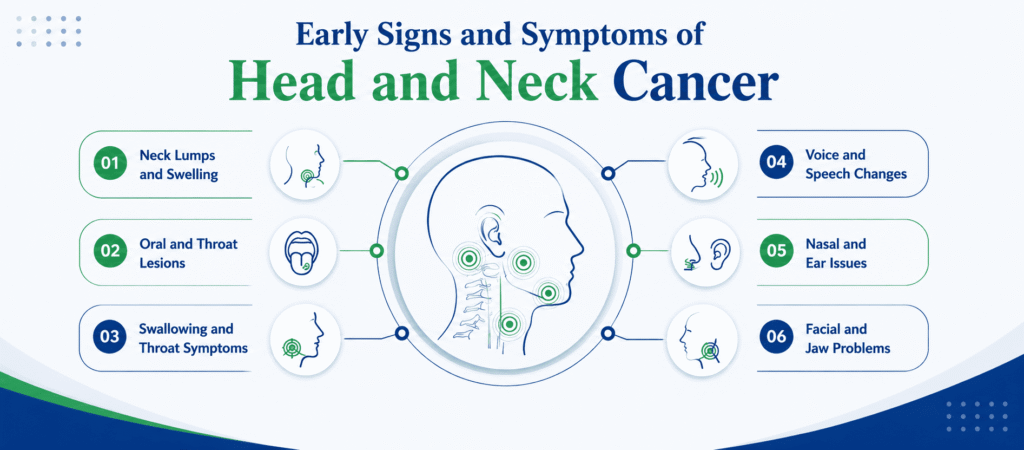
Here are the most commonly experienced early signs that must be carefully monitored:
Neck Lumps and Swelling
- A persistent or unexplained lump or swelling in the neck, including an enlarged lymph node that does not go away.
- A neck mass that gradually increases in size or occurs without an obvious infection or other cause.
Oral and Throat Lesions
- A sore or ulcer in the mouth or throat that does not heal.
- Persistent white or red patches in the mouth.
- Unexplained mouth pain, tenderness, or bleeding.
- An unusual thickening, lump, or change in the appearance of tissues inside the mouth.
Swallowing and Throat Symptoms
- Persistent sore throat that does not improve or has no apparent cause.
- Difficulty or pain when swallowing food or liquids.
- A sensation that food is sticking or something is caught in the throat.
- Persistent throat discomfort or irritation without an obvious cause.
Voice and Speech Changes
- Persistent hoarseness or a noticeable change in the voice.
- A voice that becomes unusually rough, weak, or breathy and does not return to normal.
Nasal and Ear Issues
- Persistent nasal blockage or congestion, particularly when it affects one side.
- Recurrent or unexplained sinus problems that do not improve with usual treatment.
- Frequent or unexplained nosebleeds.
- Persistent ear pain or ringing in the ears, particularly when occurring without an apparent ear infection.
Facial and Jaw Problems
- Persistent pain or swelling affecting the face or jaw without an obvious cause.
- Difficulty opening the mouth or moving the jaw normally.
- Unexplained numbness or reduced sensation in the face.
- Weakness or reduced movement of the facial muscles.
Many of these symptoms can also be caused by less serious conditions and do not necessarily indicate cancer. However, symptoms that are persistent, unexplained, or do not improve with usual treatment should be evaluated by a doctor or dentist to determine the underlying cause and support timely diagnosis when further investigation is needed.
Risk Factors for Head and Neck Cancer
Head and neck cancer can develop when abnormal cells grow uncontrollably in the mouth, throat, voice box, nose, or nearby tissues. Several factors are linked to an increased risk of head and neck cancer:
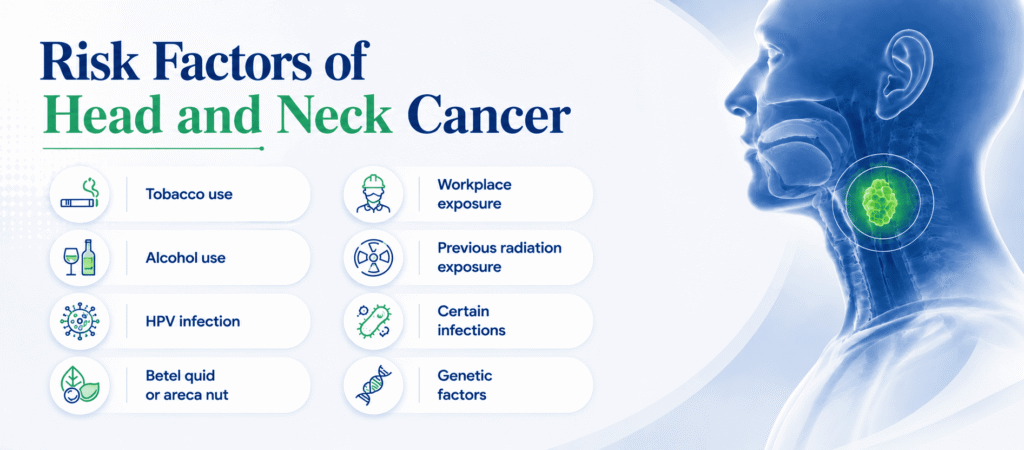
- Tobacco use: Smoking and smokeless tobacco are major risk factors.
- Alcohol use: Regular or heavy alcohol consumption increases risk, especially with tobacco use.
- HPV infection: High-risk HPV, particularly HPV-16, is linked to some throat cancers.
- Betel quid or areca nut: Regular use can increase the risk of cancers of the mouth and throat.
- Workplace exposure: Long-term exposure to substances such as wood dust or certain chemicals may increase risk.
- Previous radiation exposure: Radiation to the head or neck may increase the risk of some cancers.
- Certain infections: EBV is linked to some types of head and neck cancer.
- Genetic factors: Some inherited conditions can increase a person’s risk of developing certain cancers.
How Is Head and Neck Cancer Diagnosed?
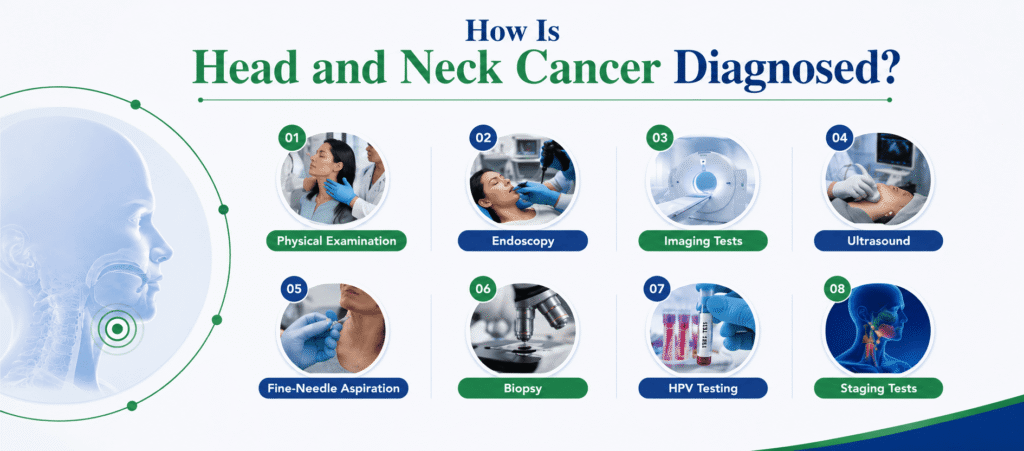
Doctors diagnose head and neck cancer using a physical examination, imaging tests, and a biopsy. These tests help identify abnormal areas, confirm cancer, and determine how far it has spread:
- Physical Examination
- Endoscopy
- Imaging Tests
- Ultrasound
- Fine-Needle Aspiration
- Biopsy
- HPV Testing
- Staging Tests
Why Is Early Detection Important for Head and Neck Cancer?
Early detection can improve treatment options, outcomes, and the chances of preserving important functions.
- Better outcomes: Early-stage cancer is generally easier to treat.
- More treatment options: May allow focused treatments such as surgery or radiation.
- Less extensive treatment: Early detection may reduce the intensity of treatment.
- Preserves function: Helps protect speech, swallowing, eating, and breathing.
- Reduces spread: Identifies cancer before it advances further.
- Act early: Persistent mouth sores, neck lumps, swallowing problems, sore throat, or voice changes should be checked promptly.
Why Choose Dr. Pushpinder Gulia for Head and Neck Cancer Treatment in Gurgaon?
Dr. Pushpinder Gulia provides specialised head and neck cancer surgery in Gurgaon, combining extensive years of surgical oncology experience with expertise in complex cancer procedures, reconstruction, and function-preserving treatment. Here is why patients choose Dr. Gulia for their treatment:
- 20+ Years of Experience: Extensive expertise in surgical oncology and complex cancer procedures.
- Specialised Head & Neck Surgery: Expertise in oral, tongue, laryngeal, pharyngeal, thyroid, and salivary gland cancers.
- Advanced & Reconstructive Surgery: Offers minimally invasive, robotic, and free-flap reconstructive procedures when appropriate.
- Personalised, Function-Preserving Care: Treatment is tailored to the cancer type and stage, with a focus on cancer control and preserving speech, swallowing, and other functions.
Final Thoughts
Recognising persistent changes early can help you get the right evaluation and treatment sooner. If you notice a neck lump, a mouth sore that does not heal, difficulty swallowing or a persistent change in your voice, speak with a doctor or dentist.
If you are concerned about your symptoms, you can consult Dr. Pushpinder Gulia in Gurgaon for an evaluation and to discuss the next steps.

 WhatsApp