
Limb Salvage Surgery vs. Amputation: What Bone Sarcoma Patients Should Know
Limb salvage surgery removes a bone sarcoma while preserving the affected limb, whereas amputation removes the involved part of the limb. Limb salvage may be possible when the tumour can be completely removed while preserving nerves, blood vessels, and useful function. Amputation may be recommended when safe limb preservation is not possible, based on tumour extent and treatment response.
What Is Bone Sarcoma and How Is It Treated?
Bone sarcoma is a rare cancer that starts in the bone, with osteosarcoma and Ewing sarcoma among the common types. Treatment may include chemotherapy and surgery. In selected patients, limb salvage surgery can remove the tumour while preserving the limb.
Main key pointers about bone sarcoma include:
- Bone sarcoma develops in the bone and can affect the arms or legs.
- Osteosarcoma and Ewing sarcoma are important types of bone sarcoma.
- Treatment depends on the tumour type, location, size, spread, and response to treatment.
- Treatment may involve chemotherapy, surgery and, in selected cases, radiotherapy.
- Surgery aims to remove the tumour with clear cancer margins.
- For suitable patients, limb salvage can preserve the affected arm or leg.
What Is Limb Salvage Surgery for Bone Sarcoma?
Limb salvage surgery removes a bone sarcoma while preserving the affected arm or leg. The tumour is removed with clear margins, followed by reconstruction when needed to restore bone stability and limb function.
Key points for limb salvage surgery include:
- The main goal is to remove the tumour without removing the entire limb.
- Surgeons carefully assess the tumour’s relationship with bones, muscles, nerves and blood vessels.
- The removed bone may need reconstruction with a tumour prosthesis, a bone graft, or another reconstructive technique.
- Rehabilitation is an important part of recovery after limb salvage surgery.
- Limb salvage is considered only when it can provide safe cancer removal and useful limb function.
- Modern imaging, chemotherapy, and reconstructive techniques have made limb preservation possible for many appropriately selected patients.
- Patients looking for limb salvage surgery in Gurgaon should undergo detailed imaging and treatment planning before surgery.
Limb Salvage Surgery vs Amputation: What Is the Difference?
Limb salvage surgery removes the tumour while preserving the limb. Amputation removes the affected part of the limb. Both can be used to treat bone sarcoma, depending on whether the cancer can be safely removed.
Here is the tabular distinction between the two:
| Limb Salvage Surgery | Amputation |
| Preserves the affected limb | Removes the affected part of the limb |
| Removes the tumour with a margin of healthy tissue | Removes the tumour along with the involved limb segment |
| May require reconstruction | May require a prosthetic limb after recovery |
| Aims to preserve useful limb function | Can provide definitive local treatment when limb salvage is not safe |
| May involve longer reconstruction and rehabilitation | Rehabilitation focuses on prosthetic use and functional adaptation |
What Does the Research Say?
Research reviewed in the available evidence indicates that overall survival can be comparable between limb salvage and amputation when adequate tumour margins are achieved. Limb salvage may offer functional and quality-of-life advantages in appropriately selected patients, but it can also involve complications, reconstruction-related problems, and further surgeries.
Therefore, neither procedure is automatically the right choice for every patient. The priority is to achieve effective cancer control while considering the expected function and long-term impact of the treatment.
When Is Limb Salvage Surgery or Amputation Recommended?
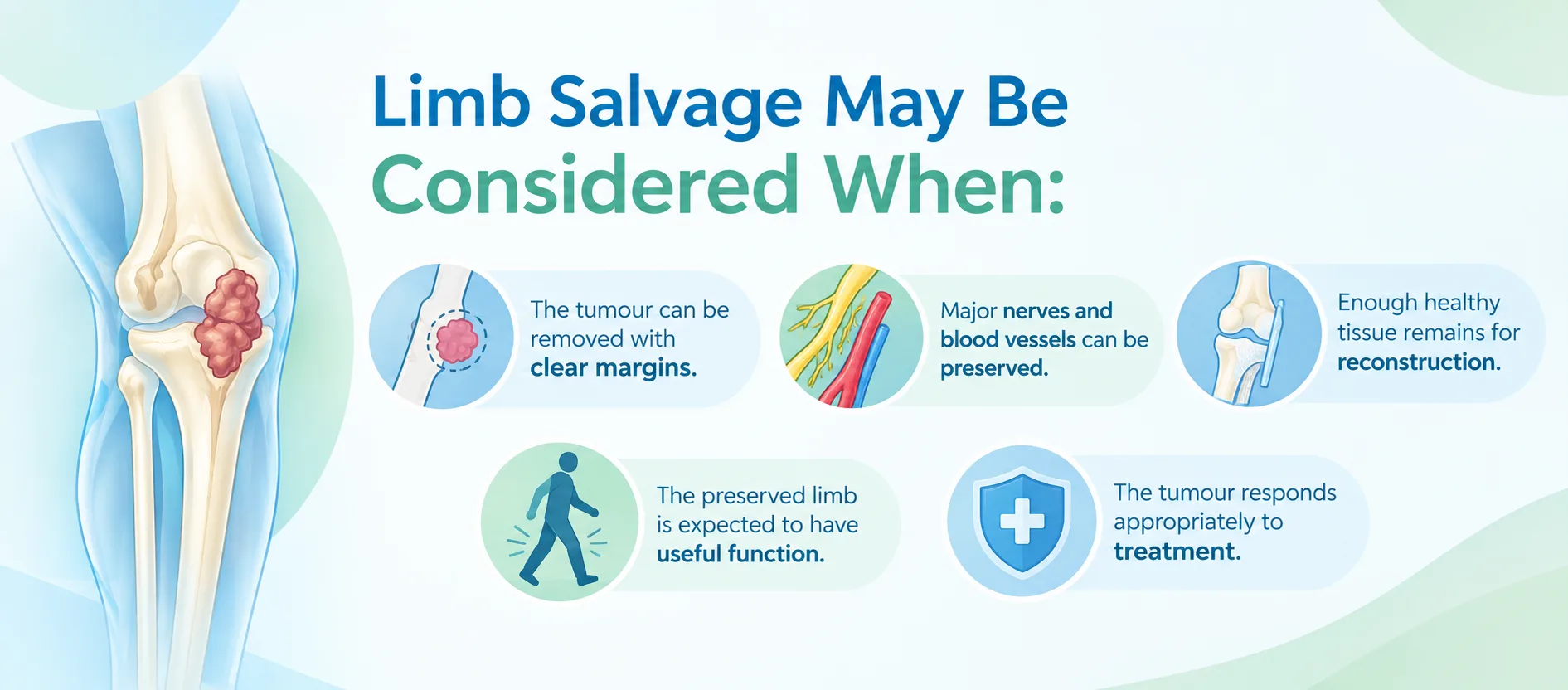
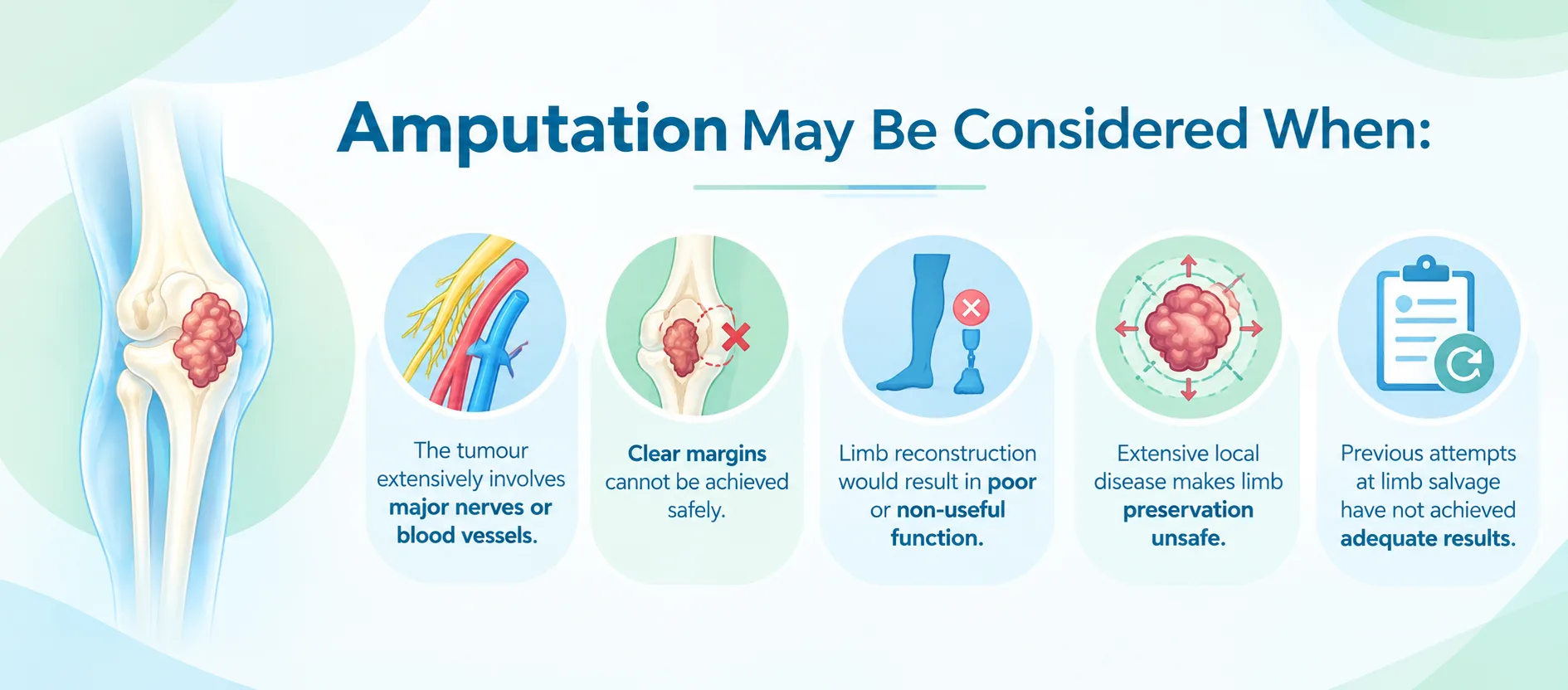
Limb salvage surgery may be considered when the tumour can be removed safely while preserving important nerves, blood vessels and useful limb function. Amputation may be needed when this is not possible.
Limb salvage may be considered when:
- The tumour can be removed with clear margins.
- Major nerves and blood vessels can be preserved.
- Enough healthy tissue remains for reconstruction.
- The preserved limb is expected to have useful function.
- The tumour responds appropriately to treatment.
Amputation may be considered when:
- The tumour extensively involves major nerves or blood vessels.
- Clear margins cannot be achieved safely.
- Limb reconstruction would result in poor or non-useful function.
- Extensive local disease makes limb preservation unsafe.
- Previous attempts at limb salvage have not achieved adequate results.
Limb Salvage Surgery vs Amputation: Risks, Recovery, and Outcomes
Limb salvage surgery can preserve the affected limb but may require complex reconstruction and longer rehabilitation. Amputation may offer a more definitive treatment in selected cases. Recovery and outcomes depend on the individual patient and treatment approach.
Limb salvage surgery:
- May involve bone or joint reconstruction.
- Recovery can include longer physiotherapy and rehabilitation.
- Possible risks include infection, implant problems, wound issues, and further surgery.
- When successful, it can help preserve limb function and quality of life.
Amputation:
- Removes the affected part of the limb and may reduce the need for repeated local surgeries in selected cases.
- Recovery includes wound healing, rehabilitation, and prosthetic training when appropriate.
- Patients can achieve good function and quality of life with suitable rehabilitation and support.
For patients considering bone cancer surgery in Gurgaon, the expected risks, recovery time, and functional outcome should be discussed based on the tumour and planned treatment.
Why Choose Dr. Pushpinder Gulia for Limb Salvage and Amputation Surgery in Gurgaon?
Dr. Pushpinder Gulia offers specialised surgical oncology care for bone sarcoma, including limb-preserving techniques and amputation surgery when clinically required.
- 23+ years of surgical oncology experience
- 5,000+ cancer surgeries
- Expertise in bone sarcoma and complex cancer surgery
- Limb-preserving and organ-preserving approaches when appropriate
- Advanced robotic and minimally invasive surgery for suitable cases
- Personalised surgical planning focused on cancer control and function
Making the Right Treatment Choice for Bone Sarcoma
Limb salvage surgery and amputation are both options for treating bone sarcoma. The choice depends on the tumour’s extent, whether it can be safely removed, and the expected limb function. A detailed evaluation is essential to plan the most appropriate treatment.
Consult Dr. Pushpinder Gulia in Gurgaon for personalised guidance on bone sarcoma surgery, limb salvage, or amputation based on your condition and treatment

 WhatsApp