
Lumpectomy vs Mastectomy: Which Is Better? Differences, Survival & Recovery
Being diagnosed with breast cancer can make treatment decisions feel overwhelming. One of the most important decisions for many patients is whether to have a lumpectomy (breast-conserving surgery) or a mastectomy.
But is one better than the other?
Not necessarily. For appropriately selected patients with breast cancer, lumpectomy followed by radiation therapy can provide survival outcomes comparable to mastectomy. The right choice depends on the size and location of the tumour, whether cancer is present in more than one area, whether radiation can be given, your overall health, and your personal preferences.
This guide explains the key differences between lumpectomy and mastectomy, when each may be recommended, survival and recurrence, radiation, recovery and how your breast surgeon decides which approach is appropriate.
Lumpectomy vs Mastectomy: Quick Comparison
| Lumpectomy | Mastectomy | |
|---|---|---|
| What is removed? | Tumour with a margin of surrounding tissue | The affected breast |
| Breast preserved? | Most of the breast remains | Breast tissue is removed |
| Radiation | Usually recommended | May or may not be required |
| Recovery | Generally shorter | Generally longer |
| Reconstruction | Usually not required | May be performed |
| Best suited for | Selected cancers that can be safely removed while preserving the breast | Cancers where breast conservation is unsuitable or not preferred |
The choice should be based on your individual diagnosis and treatment plan, not simply on how much tissue is removed. For many appropriately selected patients, both approaches can provide comparable long-term survival.
What Is a Lumpectomy?
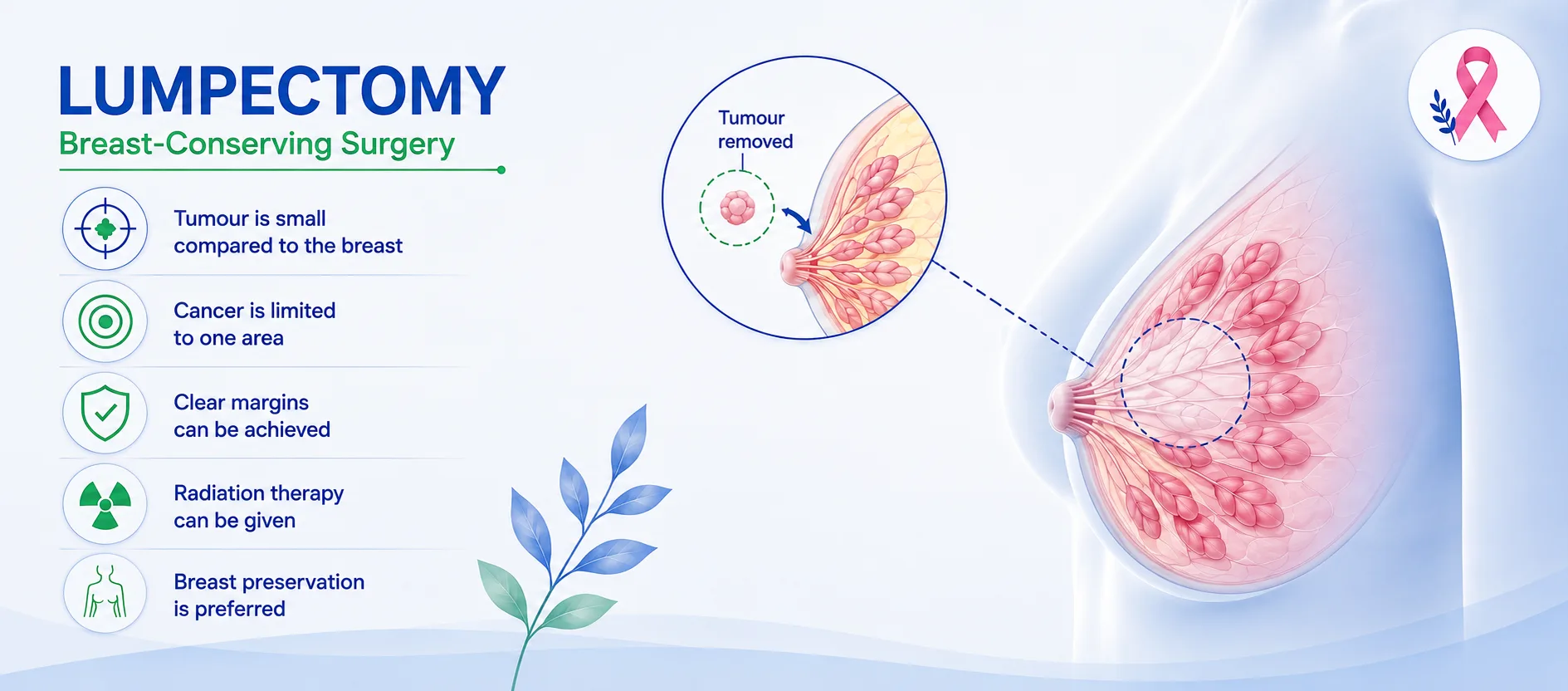
A lumpectomy, also called breast-conserving surgery or partial mastectomy, removes the cancer along with a surrounding margin of normal tissue while preserving most of the breast.
Lumpectomy may be considered when:
- The tumour is relatively small compared with the breast.
- Cancer is confined to one area.
- The tumour can be removed while achieving appropriate surgical margins.
- Radiation therapy can be safely given when required.
- Breast preservation is suitable for the patient.
After surgery, the removed tissue is examined by a pathologist. The margins are checked to determine whether cancer cells are present at the edge of the removed tissue. If cancer remains at the margin, additional surgery may sometimes be required.
What Is a Mastectomy?
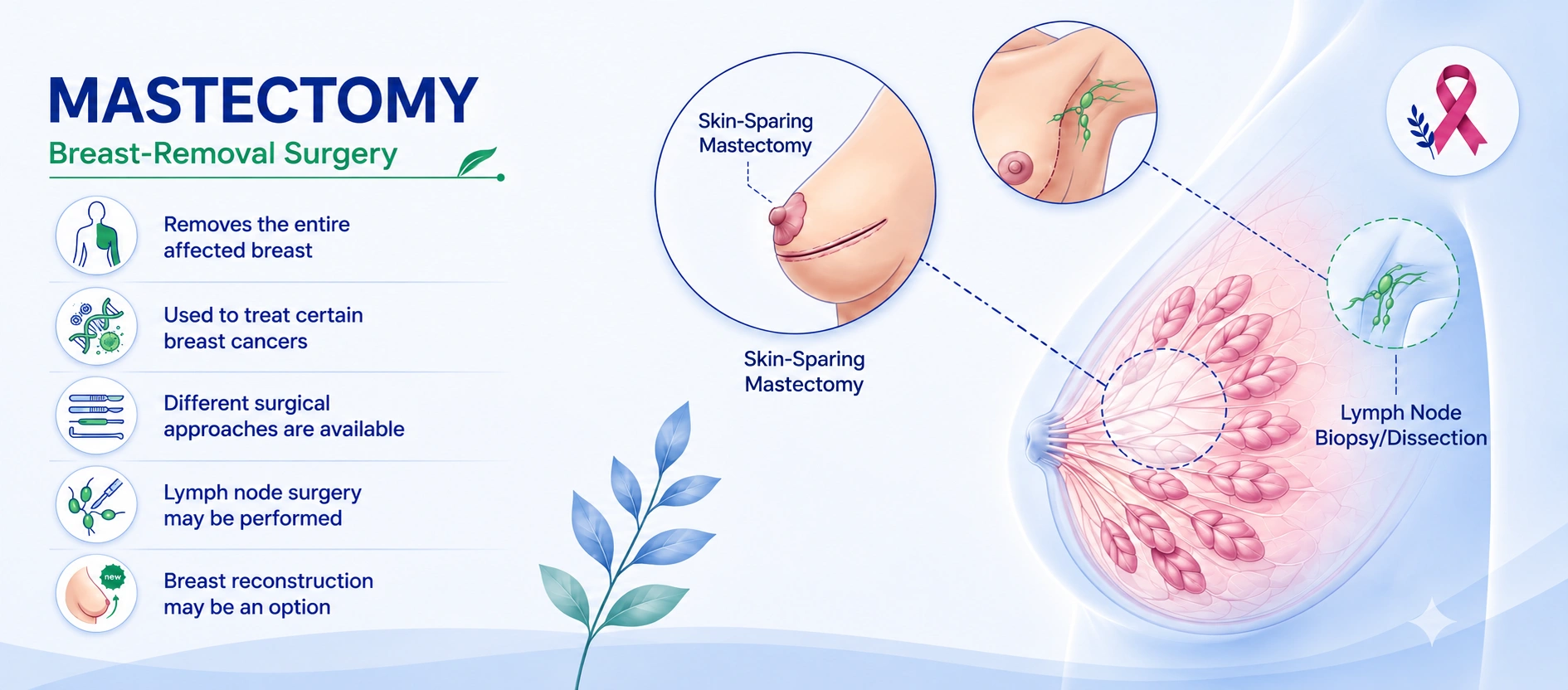
A mastectomy involves removing the breast containing the cancer. Depending on the cancer and treatment plan, different approaches may be considered, including skin-sparing or nipple-sparing mastectomy in selected patients.
Mastectomy may be recommended when:
- The tumour is large relative to the breast.
- Cancer is present in multiple areas of the same breast.
- Adequate margins cannot be achieved with breast-conserving surgery.
- Previous radiation or another medical factor makes lumpectomy unsuitable.
- The patient is unable or unwilling to undergo radiation when it is an important part of breast-conserving treatment.
- Certain genetic or high-risk factors influence the surgical decision.
- The patient chooses mastectomy after discussing the benefits and limitations of both approaches.
Breast reconstruction can be performed during mastectomy or at a later stage, depending on the patient’s treatment plan and preferences.
Is Lumpectomy or Mastectomy Better for Survival?
This is one of the most important questions patients ask.
For appropriately selected patients, lumpectomy followed by radiation therapy and mastectomy can provide comparable long-term survival outcomes. Research does not show that removing the entire breast automatically provides better survival simply because more tissue is removed.
Therefore, the decision should focus on:
- Can the cancer be completely removed with breast-conserving surgery?
- Can appropriate radiation therapy be given?
- What is the size and location of the tumour?
- Is cancer present in more than one area?
- What are the patient’s treatment goals and preferences?
Your surgeon and oncology team can help you understand which approach is appropriate for your specific cancer.
Is Breast Cancer More Likely to Come Back After Lumpectomy?
Lumpectomy does carry a somewhat higher risk of cancer returning in the treated breast compared with mastectomy. However, radiation therapy after breast-conserving surgery significantly reduces the risk of local recurrence.
Importantly, mastectomy does not completely eliminate the possibility of recurrence. A small amount of breast tissue may remain, and cancer can also recur in the chest wall or nearby tissues.
Your individual recurrence risk depends on factors such as:
- Cancer stage
- Tumour biology
- Lymph node involvement
- Surgical margins
- Response to treatment
- Other treatments such as chemotherapy, hormone therapy or targeted therapy
So, recurrence risk should be discussed in the context of your complete diagnosis, not just the type of surgery.
Will I Need Radiation After Lumpectomy or Mastectomy?
Radiation is usually an important part of treatment after lumpectomy. Its purpose is to treat microscopic cancer cells that may remain in the breast after surgery and reduce the risk of local recurrence.
After mastectomy, some patients may still need radiation depending on factors such as tumour size, lymph node involvement and other pathological findings.
This means:
Lumpectomy does not necessarily mean less cancer treatment, and mastectomy does not necessarily mean you will avoid radiation.
The complete treatment plan depends on your individual cancer.
Lumpectomy vs Mastectomy: Recovery
Recovery depends on the extent of surgery and whether procedures such as lymph node surgery or reconstruction are performed.
Recovery After Lumpectomy
Because less breast tissue is removed, recovery is generally shorter. The NCI notes that many patients can return to most usual activities within about two weeks, although individual recovery varies.
You may experience:
- Pain or tenderness
- Swelling or bruising
- Temporary changes in breast shape
- Fatigue
- A surgical scar
If radiation is required, the overall treatment journey continues after surgical recovery.
Recovery After Mastectomy
Recovery is generally longer because more tissue is removed. Some patients may also have surgical drains.
The NCI reports that it may take around 3–4 weeks to feel mostly normal after mastectomy, while recovery after mastectomy with reconstruction may take 6–8 weeks or longer, depending on the reconstruction procedure.
What Will My Breast Look Like After Surgery?
Cosmetic outcome is an important part of the decision.
After lumpectomy, most of the breast remains, but the breast may have a change in shape or a small indentation depending on the size and location of the tumour and the amount of tissue removed.
For selected patients, oncoplastic breast surgery can combine cancer removal with breast-shaping techniques to improve the cosmetic result.
After mastectomy, patients may choose:
- No reconstruction
- An external breast prosthesis
- Implant-based reconstruction
- Tissue-based reconstruction
Reconstruction may be performed immediately or later depending on the patient’s cancer treatment plan.
How Do Doctors Decide Between Lumpectomy and Mastectomy?
There is no single factor that determines the right operation.
Your breast surgeon will typically consider:
1. Tumour size and location
A small tumour in a favourable location may be suitable for breast-conserving surgery, while a larger tumour relative to breast size may make mastectomy more appropriate.
2. Number of cancerous areas
Cancer in multiple areas of the breast can influence whether breast conservation is appropriate.
3. Surgical margins
The cancer needs to be removed appropriately. If clear margins cannot be achieved with lumpectomy, additional surgery or mastectomy may be considered.
4. Radiation therapy
If lumpectomy is chosen, radiation is commonly part of the treatment plan. Your ability to receive radiation therefore matters.
5. Genetic and family history
Certain inherited mutations or a strong family history may influence discussions about the risk of future breast cancer and surgical options.
6. Your preferences
When both approaches are medically appropriate, your preferences regarding breast preservation, reconstruction, recovery, radiation and quality of life are important.
Which Surgery Is Right for You?
There is no universal answer to “lumpectomy vs mastectomy – which is better?”
For one patient, preserving the breast with lumpectomy followed by radiation may be an excellent option. For another, mastectomy may provide the most appropriate cancer treatment.
The most important question is not:
“Which surgery removes more?”
It is:
“Which treatment provides appropriate cancer control for my diagnosis while fitting my medical needs and personal priorities?”
A detailed discussion with a surgical oncologist can help you understand the benefits, limitations and expected recovery of each option before you make a decision.
Discuss Your Breast Cancer Surgery Options With Dr. Pushpinder Gulia
Choosing between lumpectomy and mastectomy is a highly individual decision. Your tumour characteristics, stage, imaging, pathology, treatment requirements and personal preferences all need to be considered together.
Dr. Pushpinder Gulia is a Surgical Oncologist in Gurgaon with expertise in breast cancer surgery, including breast-conserving surgery, mastectomy, oncoplastic procedures and sentinel node surgery. He has 23+ years of experience in surgical oncology.
If you have recently been diagnosed with breast cancer or have been advised to undergo lumpectomy or mastectomy, a consultation can help you understand your surgical options and develop a treatment plan appropriate for your diagnosis.
[Book a Consultation with Dr. Pushpinder Gulia]
Medical Sources
The following authoritative sources can be used as the article’s medical references:
- National Cancer Institute — Choosing Between a Lumpectomy and Mastectomy
- National Cancer Institute — Lumpectomy
- National Cancer Institute — Breast Reconstruction After Mastectomy
- American Cancer Society — Breast-Conserving Surgery (Lumpectomy)
This article is intended for general educational purposes and should not replace personalised medical advice from your treating cancer team.

 WhatsApp